Testing and measurement
EPC and max CPC calculator
Earnings per ad click (EPC) is what a sale is worth to you multiplied by the share of ad clicks that end in a sale, which through a presell is presell click-through × order-page conversion. That EPC is also your break-even CPC. Your maximum bid is EPC × (1 − the margin you want to keep).
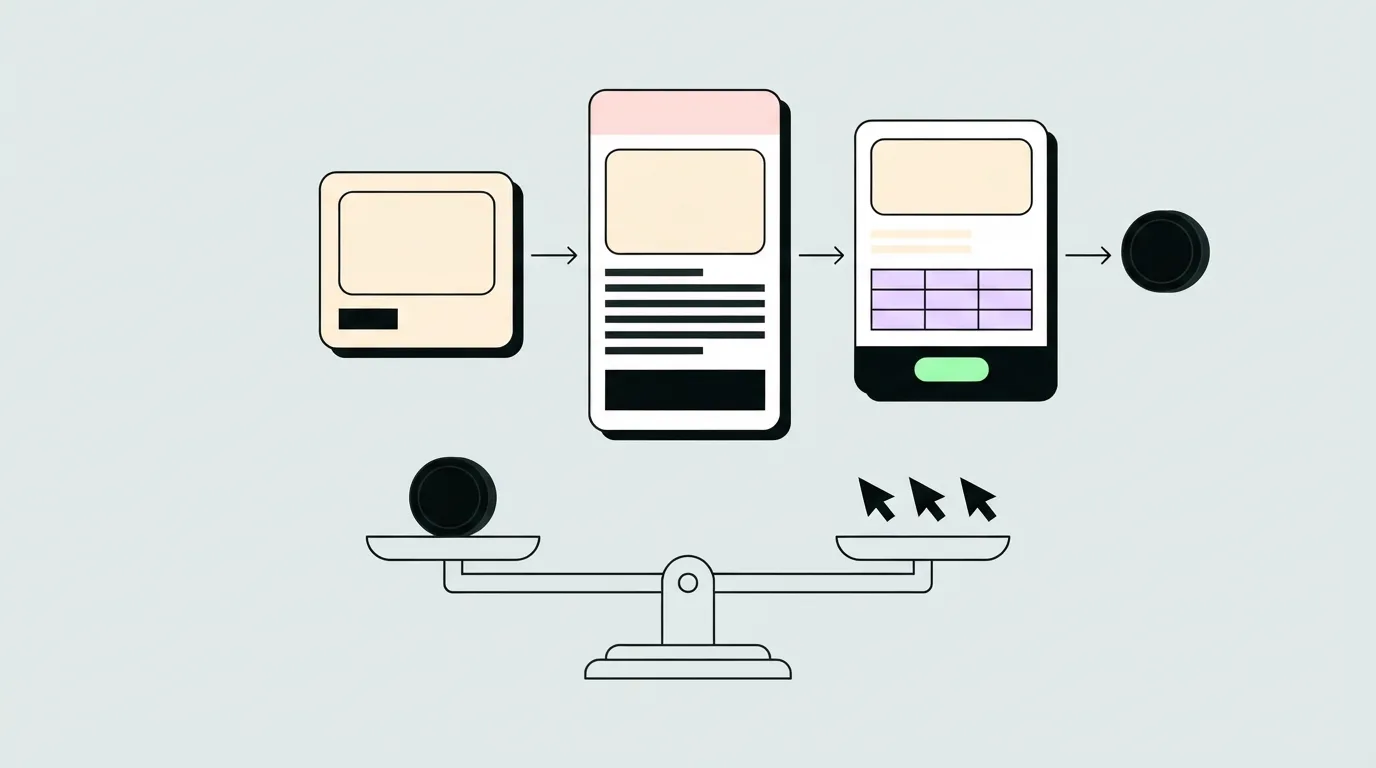
Enter what your tracker already says about one traffic source: how many ad clicks reach the offer page through your presell, how many of those buy, and what a sale is worth to you. The calculator returns earnings per ad click, the CPC where you break even, and the highest bid that still keeps your target margin. The result is an estimate built only from the rates you type in. The method and its sources sit under the tool.
A note on the name: most searches for "EPC calculator" are about UK Energy Performance Certificates for homes. This page is for affiliates, media buyers and offer owners buying traffic to a presell funnel. If your rates are not split by source yet, start with how to measure presell-to-sale conversion by traffic source, because a blended rate gives you a blended bid that fits none of your sources.
The calculator
Treat the output as a planning estimate. It assumes your rates stay the same at the bid you choose, and a higher bid often buys different placements with different rates.
The formulas behind it
AffBuddy's glossary defines EPC as the average revenue an affiliate earns for every click sent to an offer, calculated as total commissions divided by total clicks. Once a campaign has run, that is the figure your tracker shows. To plan a bid before then, or for a new source, you build the same number from the funnel's rates:
- Net conversion = presell click-through × order-page conversion
- Value per sale = payout × approval rate for an affiliate offer, or order value × gross margin − fulfilment for your own product
- EPC per ad click = net conversion × value per sale
- Break-even CPC = EPC
- Max CPC = EPC × (1 − target margin)
The chain comes from OpenAdLibrary's guide to calculating breakeven CPC. It gives the overall conversion rate with a pre-lander as pre-lander click-through times offer conversion, states that at breakeven CPC equals EPC, and sets the max bid at breakeven CPC × (1 − target margin). The same guide tells you to use net payout, after refunds, chargebacks and lead rejections, which is what the approval rate field is for. For a product you sell yourself it treats the payout as contribution margin: order value times gross margin, minus fulfilment.
Worked example: an affiliate offer
Say the offer pays $70 a sale, 32% of ad clicks reach the offer page through your presell, and 2.5% of those buy. Net conversion is 0.32 × 0.025 = 0.8%, so one ad click in 125 becomes a sale. EPC is 0.008 × $70 = $0.56, which is also where you break even. To keep 30% of those earnings after paying for traffic, bid no more than $0.56 × 0.7, about $0.39.
Now suppose the network reverses one sale in ten. With the approval rate at 90%, each sale is worth $63, EPC falls to about $0.50 and the max bid to $0.35. A refund rate you leave out shows up later as a bid that was four cents too high on every click. These figures are the ones preloaded in the calculator, made up for the illustration.
Worked example: your own product
A $120 average order at 40% gross margin leaves $48. Take off $8 for shipping and fees and each order contributes $40. With 45% presell click-through and 3% checkout conversion, net conversion is 1.35% and EPC is 0.0135 × $40 = $0.54. At a 30% target margin the max bid is about $0.38.
Enter the full order value as if it were the payout and the calculator reports an EPC of $1.62. Bidding against that figure means paying three times what a click is worth.
What to plug in from real campaigns
Take both rates from your tracker or analytics for one source and one presell variant at a time. The presell conversion guide sets out the events and the click-ID chain that make those numbers trustworthy. A rate measured on a handful of sales swings from week to week, and so does the bid it produces, so recalculate as the counts grow.
Skip the EPC a network or marketplace shows next to an offer when you set a bid. That figure averages every affiliate's traffic, sources and pages, and your funnel is one of many inside it. The rule underneath stays simple, and an AffiliateFix thread on bidding from commissions puts it plainly: your CPC needs to be lower than your EPC.
Watch the order-page rate whenever you work on presell click-through. A presell that sends more readers to the offer can send colder ones, so click-through rises while EPC falls. Remoby's presell framework calls EPC the scorecard and CTR the warning light. Enter both rates for each variant and judge them on the EPC tile.
Our take
We'd start every new source at the max-CPC figure and treat break-even as a ceiling, worth touching only while the rates are still being measured. Before raising a bid, we'd rerun the numbers for each presell variant, because a variant that lifts order-page conversion raises the ceiling without any change to the offer.
We'd never leave approval at 100% on a network that reverses sales. The affiliate example shows what a 10% reversal rate does to the bid.
Where this fits in your testing
Presell split tests are decided on earnings per click. Binom's course on split testing landers and offers says to compare variants on EPC, and OpenAdLibrary's test of whether pre-landers increase conversions judges a presell arm against a direct-link arm by end-to-end earnings per ad click. To model the direct arm here, set presell click-through to 100%. How long to run each arm and when to stop are covered in landing page split testing for presells.
Changing the presell format changes the two rates. The payout stays where it was.
For the format itself, read VSL presell or text presell: which to run first, the guide to building a listicle presell page, or what to put on a bridge page for affiliate offers. The testing and measurement hub gathers the measurement guides, and all presell guides are listed newest first.